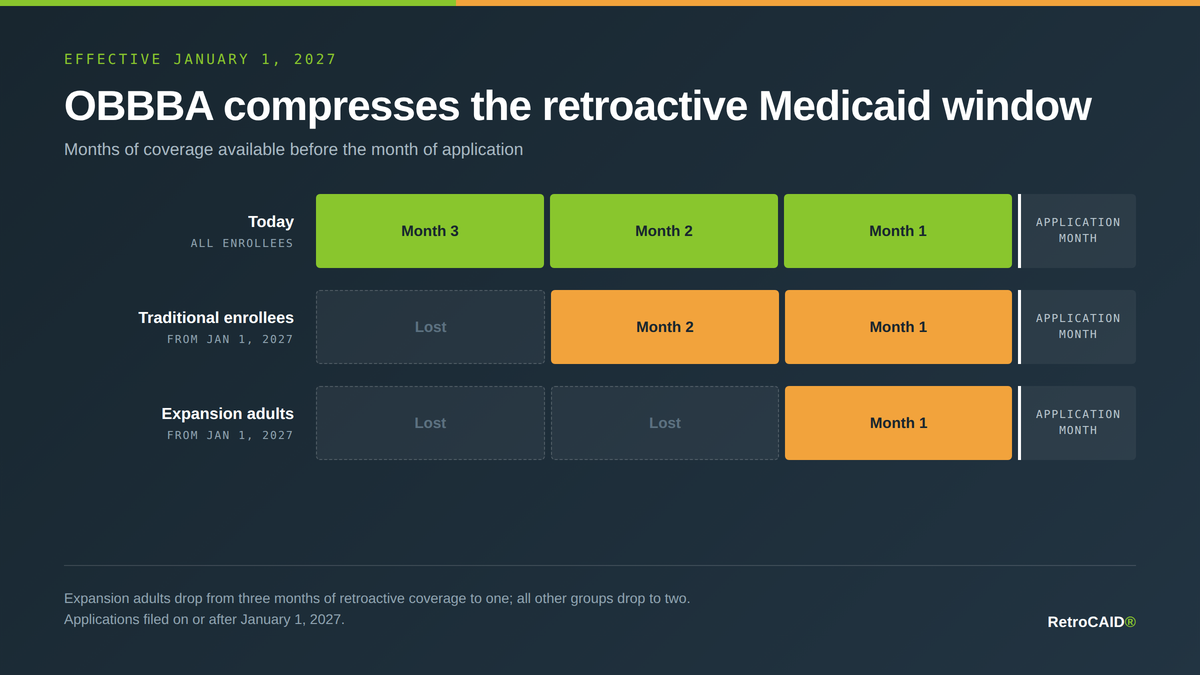
H.R.1, also known as The One Big Beautiful Bill Act (OBBBA), changes Medicaid eligibility in two directions at once: OBBBA Medicaid eligibility rules make coverage more volatile, and they shorten the time providers have to recover the care those changes affect. Six-month redeterminations and work requirements increase coverage churn, while the retroactive coverage window drops to one month for expansion adults and two months for all other groups on applications filed January 1, 2027 or later.
Most of the public conversation about OBBBA has centered on taxes. For safety-net providers, the real story is what the law does to Medicaid eligibility itself. The result isn’t just more uninsured patients — it’s a structural problem with how most facilities find reimbursable encounters in the first place.
Medicaid eligibility was never simply active or inactive
A patient’s Medicaid status goes far beyond a simple Active/Inactive response. It’s a living Benefit Profile with many variables that can shift at any time — often after eligibility is first confirmed. Coverage can be denied and then approved on appeal months later. Documentation delays can push a final determination well past the date of service. Benefits expand or contract, coverage lapses and is reinstated, and secondary, tertiary, or TPL payers get added or removed.
Each of those changes can turn an encounter you’d already written off into a fully reimbursable claim. The catch: the change rarely announces itself, and it almost never lands on the day you happen to run an eligibility check.
The reimbursable change almost never lands on the day you happen to run an eligibility check.
What changes
Which OBBBA Medicaid eligibility rules increase churn
Two provisions make the Benefit Profile far more volatile, right as a third shrinks your time to act.
All three take effect January 1, 2027. See the National Health Law Program’s analysis of the retroactive coverage rollback and the AMA’s implementation-date summary for the underlying provisions.
-
More churn
Six-month redeterminations
Expansion adults must re-establish eligibility twice as often — doubling coverage transitions and the paperwork-driven drop-offs that come with them.
-
More churn
Community engagement requirements
New 80-hour monthly reporting pushes eligible patients in and out of coverage over administrative gaps, not true ineligibility.
-
Less time
A shorter retroactive window
For applications filed on or after January 1, 2027: one month before the month of application for expansion adults, two months for all other groups — down from three.
What is the difference between eligibility checking and eligibility monitoring?
Eligibility checking is a manual, periodic query that returns a patient’s status at one moment in time. Eligibility monitoring is an autonomous, always-on process that watches the full Benefit Profile across the entire timely-filing window and surfaces the moment an encounter becomes reimbursable. Because OBBBA Medicaid eligibility changes increase churn, the gaps between checks are exactly where the reimbursable changes happen.
Advanced Medicaid Intelligence
How RetroCAID® monitors the Benefit Profile
RetroCAID® monitors every applicable encounter in three stages — continuous detection, claim-level validation, and a billing-ready alert — autonomously and across the full timely-filing window. See how it works in detail.
What Benefit Profile changes does RetroCAID® detect?
RetroCAID® monitors the full Benefit Profile, capturing the reimbursable moments periodic checks were never built to see:
- Eligibility status changes
- Payer changes and dual eligibility
- Benefit redeterminations
- Lapsed and reinstated benefits
- Late-addition secondary, tertiary, or TPL payers
- Spend-down and PCP changes
The clock is already running
Under OBBBA, speed is the whole game
A shorter retroactive window punishes delay. The moment an encounter becomes reimbursable, the clock to capture it is already running — and it’s shorter than it used to be. Always-on monitoring across the entire timely-filing window is the only way to catch the change while it’s still billable, instead of discovering it after it’s expired into bad debt.
Common questions